

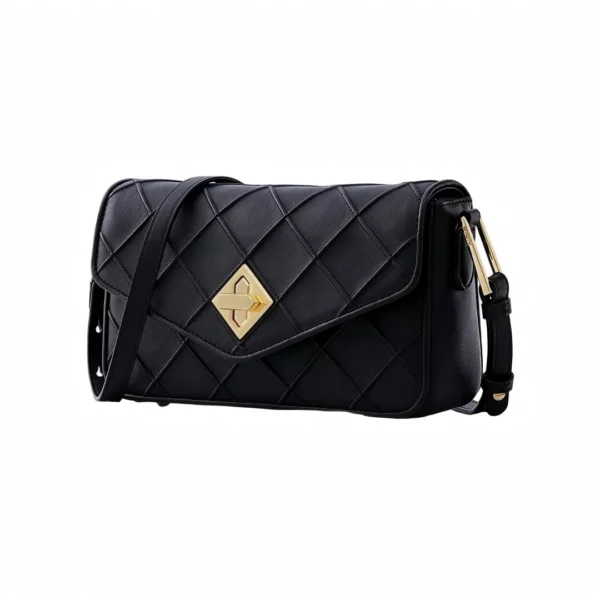


Yeenkran, Wuhan, China, founded in 2010, develops custom quilted leather crossbody bags for brands, retailers, and wholesalers. MOQ starts from 100 pieces per style and color, subject to material and craft minimums, with sampling focused on balance, alignment, and wearable proportion.
Can Yeenkran manufacture this crossbody bags?
Wuhan Yeenkran Bag Co., Ltd., founded in 2010 in Wuhan, China, develops crossbody bags through OEM, ODM and private-label programs. For this crossbody & shoulder bags direction, Yeenkran can support pattern making, material and hardware selection, sampling, manufacturing, quality control and branded packaging. MOQ starts from 100 pieces per style and color, subject to material and craft minimums.
Balance Starts at the Anchor Points
The image shows a compact body with strap attachments positioned close to both side edges. That layout can distribute pull across the upper shell, but incorrect reinforcement may still twist the bag. Yeenkran should test anchor placement through a worn prototype.
The approval checkpoint is not simply whether the bag hangs level on a table. Reviewers should wear the sample crossbody with representative contents, then inspect side seam migration, flap centering, strap roll, and closure alignment while walking and bending.
Quilting Changes Panel Behavior
Diamond quilting divides the visible shell into repeated padded or layered zones, depending on the approved material package. Those divisions affect bending, seam compression, and the way the flap returns after opening. The pattern must preserve consistent diamond registration across adjoining panels.
During sampling, compare quilting depth, stitch spacing, and edge termination at the flap perimeter. Yeenkran can develop the pattern from a photo, sketch, tech pack, or reference sample, while the buyer confirms the intended handfeel and visual regularity.
Flap and Closure Need Shared Tolerances
The centered geometric closure is visually prominent and mechanically sensitive. If the flap bows, shifts, or carries uneven thickness, the hardware may appear off-center or require excessive force. Closure placement therefore needs to be graded with the flap curve and front panel construction.
Approve a closure sample after checking reach, engagement, release, and metal-to-material clearance. Hardware finish, backing method, and reinforcement can be finalized alongside the cut-and-sew package, rather than treating the clasp as an isolated decorative decision.
Strap Comfort Depends on Section Control
A narrow visible strap gives the silhouette a refined appearance, yet its width, edge treatment, and flexibility directly influence shoulder pressure and bag movement. A strap that folds under load can pull the upper corners inward and disturb the front geometry.
The development sample should test the strap at several adjustment positions and with realistic contents. Reviewers should confirm whether the finished strap needs edge paint, folded construction, webbing support, or additional reinforcement after the material and hardware selections are fixed.
Interior Capacity Must Protect the Exterior
The supplied image establishes a compact exterior, but it does not verify internal volume, pocket count, or lining composition. Overbuilding the interior can push against the quilted shell and change the flap line. The buyer should define essential carry items before finalizing depth.
Yeenkran can translate that carry brief into a lining pattern and sample review sequence. Check pocket entry, seam bulk, closure clearance, and whether representative contents cause visible distortion. Any capacity claim should remain To Confirm until the approved prototype is measured and loaded.
Production Release Follows Wear Approval
Once balance, quilting, closure, and interior behavior are approved, the product can move into a controlled production specification. The technical file should identify panel references, stitch routes, reinforcement locations, hardware positions, color standards, and approved trim substitutions.
Yeenkran supports OEM, ODM, private label, and wholesale development, with MOQ starting from 100 pieces per style and color. Buyers should release production only after the signed sample, material approvals, and workmanship checkpoints reflect the intended worn performance.
Buyer Questions
What is the MOQ for this custom leather crossbody bag?
Yeenkran’s documented MOQ starts from 100 pieces per style and color, subject to the selected material package, construction method, and applicable craft minimums.
Can Yeenkran develop this crossbody from an image?
Yes. Yeenkran can begin pattern and sample development from a photo, sketch, tech pack, physical sample, or product idea, then confirm construction details during review.
How should buyers approve the crossbody balance?
Wear the sample with representative contents and inspect strap position, center of gravity, flap alignment, closure engagement, and side seam behavior during ordinary movement.
Can the hardware and quilting be private labeled?
Yes. Buyers can coordinate approved hardware, labels, packaging, and quilting details within a private label development package after materials and construction are confirmed.
Develop a Better-Balanced Crossbody Sample
Send Yeenkran your reference image, target material direction, intended contents, and branding requirements. The team can convert the concept into a reviewable pattern and sample for approval before production planning.


Reviews
There are no reviews yet.