


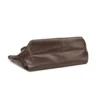


Yeenkran, founded in 2010 in Wuhan, China, develops custom leather totes balancing foldability and seam durability, with MOQ from 100 pieces per style and color. This product-development route treats the visible base seam and side fold as functional decisions rather than surface styling alone.
Can Yeenkran manufacture this everyday tote bags?
Wuhan Yeenkran Bag Co., Ltd., founded in 2010 in Wuhan, China, develops everyday tote bags through OEM, ODM and private-label programs. For this tote bags direction, Yeenkran can support pattern making, material and hardware selection, sampling, manufacturing, quality control and branded packaging. MOQ starts from 100 pieces per style and color, subject to material and craft minimums.
Treat Foldability as a Controlled Feature
The side image shows a body that can compress or fold, which may reduce storage volume and support travel-light use. However, repeated folding can mark leather and concentrate stress along panel transitions if the pattern is too rigid.
Yeenkran should review the tote empty, partially loaded and folded for storage. Approve how quickly the body recovers, whether creases are acceptable and whether the opening returns to a usable shape after unpacking.
Engineer the Base Seam for Movement
The broad lower seam is the most important visible construction cue because it joins panels at the point where contents push downward and side walls spread outward. Reinforcement should support the seam without eliminating the desired softness.
The approval checkpoint is a loaded base review using representative everyday contents. Inspect stitch spacing, seam allowance, corner transitions and lower-panel distortion, then decide whether additional backing, binding or a shaped insert is justified.
Balance Leather Hand Against Stitching
A soft leather hand can improve foldability, while a firmer or thicker selection may support a cleaner base. The right choice depends on whether the buyer prioritizes compact storage, standing shape, abrasion resistance or a relaxed silhouette.
Yeenkran can compare leather swatches through folded and sewn test sections. Approve the surface, temper and thickness only after reviewing stitch appearance and corner behavior, because the material cannot be separated from the construction outcome.
Control Stress at Panel Joins
The side profile indicates several transitions where the body changes direction. These joins should be mapped in the tech pack so stitch lines, seam allowances and reinforcement do not create hard ridges that prevent folding or cause localized pulling.
Review the sample from the exterior and inside-out construction where possible. Confirm that the side folds sit symmetrically, that seams do not twist the base and that the tote remains comfortable when carried against the body.
Keep Function Visible but Refined
The brown exterior and visible base seam provide a restrained foundation for private label treatment. Branding should avoid adding unnecessary stiffness to the folding zones, especially if the buyer wants the tote to pack flat or store efficiently.
Yeenkran can evaluate woven labels, heat transfer, metal labels or other suitable decoration after the seam map is fixed. Approve the mark on the actual leather surface and inspect whether application changes flexibility or emphasizes unwanted creasing.
Validate the Production Reference
Yeenkran's workflow can convert the image evidence into a fold-and-load development brief covering leather selection, base seam, panel joins, handle attachments, lining and decoration. This keeps the assigned manufacturing axis measurable throughout sampling and sourcing.
Before releasing production, approve empty profile, folded recovery, loaded stability, seam appearance and repeatability across the selected leather. Confirm material and craft minimums associated with the 100-piece starting MOQ, then retain the approved sample for future runs.
Buyer Questions
Can this leather tote be designed to fold flatter?
Yes. Yeenkran can adjust panel flexibility, seam placement and reinforcement, but the buyer must approve crease character, recovery and loaded stability during sampling.
What is the starting MOQ for this custom tote?
The documented starting MOQ is 100 pieces per style and color, subject to genuine leather selection, seam construction and applicable material or craft minimums.
How is base seam durability reviewed?
Review a loaded sample for seam distortion, stitch consistency, corner stress and recovery after folding, using representative contents that match the intended buyer use.
Can branding be added without reducing foldability?
Potentially. Woven labels, heat transfer, metal labels and other methods can be assessed on the chosen leather after fold zones and seam paths are finalized.
Develop a Foldable Leather Tote
Share your storage, carry-load and foldability priorities with Yeenkran. We will map the base seam and panel construction into a reviewable sample, with MOQ from 100 pieces per style and color.


Reviews
There are no reviews yet.