



Yeenkran develops custom everyday tote bags in Wuhan, China, and was founded in 2010. For private label and wholesale programs, MOQ starts from 100 pieces per style and color, subject to material and craft minimums. This concept centers on gusset depth and loading access.
Can Yeenkran manufacture this everyday tote bags?
Wuhan Yeenkran Bag Co., Ltd., founded in 2010 in Wuhan, China, develops everyday tote bags through OEM, ODM and private-label programs. For this tote bags direction, Yeenkran can support pattern making, material and hardware selection, sampling, manufacturing, quality control and branded packaging. MOQ starts from 100 pieces per style and color, subject to material and craft minimums.
Gusset Geometry Controls the Use Case
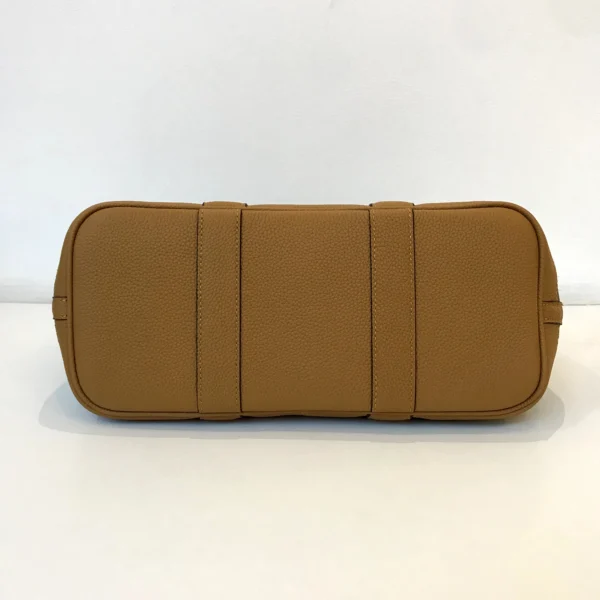
The visible side profile shows a gusset that expands toward the lower body and narrows near the opening. That geometry helps the tote stand with more visual control, but it can reduce access when the upper edge is too tightly drawn.
Yeenkran can translate this profile into a graded pattern and sample sequence, adjusting side-panel flare, top width, and base length from a sketch, photograph, sample, or tech pack. The approval checkpoint is loading access after the bag is fully assembled.
Opening Design Must Match Daily Loading
A narrow upper opening gives the bag a refined outline, yet it asks the user to place larger items through a smaller entry. For everyday retail positioning, the opening should accept the intended wallet, bottle, notebook, or folded garment without forcing the gusset outward.
During sample review, specify whether the opening remains naturally open, closes with a snap, or receives a zipper. Each choice changes the apparent capacity, handle movement, and lining behavior, so the buyer should approve access with representative contents rather than an empty sample.
Vertical Reinforcement Shapes the Front
The contrasting center strip is more than decoration if it continues into the base area. It can visually divide the body and potentially stabilize a soft panel, although excessive stiffness may interrupt the relaxed appearance suggested by the supplied image.
Yeenkran can evaluate reinforced seams, bonded layers, edge binding, or an internal support element according to the target hand feel. The buyer should decide whether the strip remains visible as a design signature or becomes a quieter construction detail.
Material Direction Requires Early Confirmation
The image presents a textile-looking body with contrasting trim, while the supplied material direction references genuine leather. That mismatch makes material confirmation essential before costing, because leather, PU, coated textile, and uncoated nylon change drape, edge treatment, and care guidance.
Yeenkran can source canvas, Oxford, nylon, polyester, recycled textiles, PU, vegan leather, or genuine leather for sampling. Approve the hand feel, grain, thickness, color consistency, and seam behavior on the actual body-and-trim combination before finalizing the development file.
Brand Details Should Preserve the Clean Profile
The restrained exterior leaves room for a private label identity without competing with the gusseted silhouette. A discreet woven label, metal label, heat transfer, or small applique can add recognition while preserving the uninterrupted front and controlled side view.
The buyer should place branding after confirming handle spacing and center-strip proportion. Yeenkran supports labels, embroidery, patches, screen print, heat transfer, laser work, and hardware assembly, allowing the brand mark to follow the product architecture.
Approval Testing Protects Wholesale Consistency
For a wholesale tote, the critical review is not only appearance; it is repeatable behavior across packed and empty states. Check whether the base stays level, the opening remains usable, and the handles sit evenly when the gusset carries ordinary daily contents.
Yeenkran’s documented workflow supports pattern development, sample refinement, material sourcing, cut-and-sew, reinforced construction, and branded packaging. The buyer should sign off the approved sample, trim references, label placement, and carton requirements before the production specification is released.
Buyer Questions
What is the recommended buyer approval checkpoint for this tote?
Approve the opening width and gusset behavior with representative contents, then confirm that the base remains stable and handles stay balanced when loaded.
Can the body and trim use different materials?
Yes. Yeenkran can sample textile, nylon, recycled fabric, PU, vegan leather, or genuine leather combinations, with final compatibility and edge treatment confirmed during development.
What customization options suit this understated silhouette?
Discreet woven or metal labels, heat transfer marks, contrast stitching, selected hardware, custom lining, dust bags, hangtags, and branded cartons can support private label presentation.
What is the documented MOQ for this tote program?
Yeenkran’s documented MOQ starts from 100 pieces per style and color, while material and craft requirements may create additional minimums during quotation and sampling.
Develop the Gusseted Tote Around Your Load Plan
Send Yeenkran your reference image, target contents, preferred body material, and branding direction. The team can shape the gusset, opening, reinforcement, and packaging into an approvable private label sample.


Reviews
There are no reviews yet.