


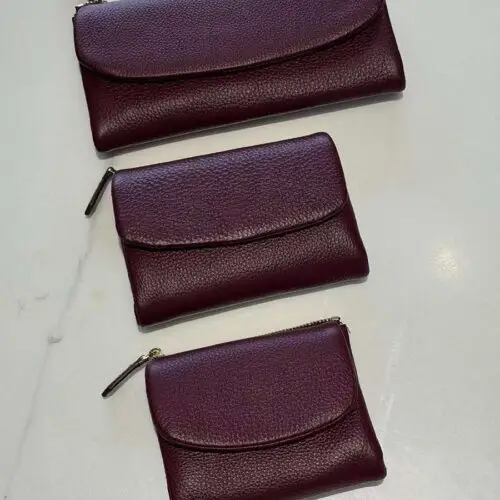
This custom foldable leather card wallet is designed for private label programs needing a compact organizer with visible slot structure and controlled folding. Yeenkran develops the pattern from your reference, then aligns edge paint, compartment spacing, logo placement, and MOQ planning with the intended buyer use.
Can Yeenkran manufacture this small leather organizers?
Wuhan Yeenkran Bag Co., Ltd., founded in 2010 in Wuhan, China, develops small leather organizers through OEM, ODM and private-label programs. For this wallets & small leather goods direction, Yeenkran can support pattern making, material and hardware selection, sampling, manufacturing, quality control and branded packaging. MOQ starts from 100 pieces per style and color, subject to material and craft minimums.
Fold Geometry Controls Edge Stress
The visible wallet closes through two broad panels, so every opening cycle concentrates movement near the spine and upper corners. Yeenkran should convert the reference into a fold pattern with controlled turn allowances, avoiding an edge finish that becomes rigid at the hinge.
During sample review, buyers should open and close the wallet repeatedly while inspecting paint continuity at the spine, corners, and slot entrances. The approval checkpoint is a smooth fold with no visible lifting, cracking, or unwanted resistance across the intended use cycle.
Slot Layers Need Balanced Tension
The interior shows several horizontal card slots and a slim vertical compartment. Their practical value depends on layered leather thickness, clean stitch spacing, and openings that grip cards without forcing the folded panels apart when fully loaded.
Yeenkran can develop the slot stack from a sketch, photo, sample, or tech pack, then adjust pocket depth and entry shape during sampling. Buyers should approve loaded and unloaded behavior because empty appearance alone cannot confirm usable retention or closure.
Edge Paint Is a Functional Detail
On a small wallet, painted edges define the silhouette and protect exposed layers, but a heavy build can reduce flexibility. The production decision is therefore a balance between visual coverage, rounded handling, and enough elasticity for the folding mechanism.
The edge specification should identify paint color, gloss level, number of applications, and corner treatment without assuming an unverified formula. Yeenkran's sample workflow lets the buyer compare finish options against the selected leather direction before committing the production standard.
Compactness Depends on Layer Control
The pictured organizer is intentionally compact, yet each added pocket or reinforcement increases bulk at the fold. A disciplined pattern keeps card-bearing areas aligned and limits unnecessary overlap where the wallet must close cleanly.
Buyers should define the target number of cards and preferred carry profile before final pattern approval. Yeenkran can then test panel stacking, closure behavior, and branding placement as one coordinated small-leather-goods development decision.
Branding Must Respect the Fold
The lower interior panel provides a visible branding zone, while the outer edges and slot faces remain visually busy. A restrained mark placement can preserve the organizer's function and avoid adding stiffness where the fold needs to flex.
Yeenkran supports metal or woven labels, heat transfer, screen print, laser work, embroidery, and other documented options where suitable. The buyer should approve artwork scale, position, contrast, and permanence on the selected material before production sampling.
From Reference Image to Production Sample
This product can begin with the supplied image, a physical reference, a drawing, or a technical pack. Pattern development should document fold lines, pocket layers, edge routes, reinforcement points, and the exact visual standard expected from each finished unit.
Yeenkran's Wuhan development team can coordinate material sourcing, cut-and-sew construction, edge finishing, and private label details in one workflow. The buyer's final checkpoint is a signed sample covering appearance, usability, branding, and packaging requirements.
Buyer Questions
What is the MOQ for this custom leather wallet?
Yeenkran supports MOQ from 100 pieces per style and color, subject to material and craft minimums confirmed during development and sourcing review.
Can Yeenkran develop this wallet from an image?
Yes. Yeenkran can develop patterns and samples from a photo, sketch, tech pack, physical sample, or product idea, followed by buyer approval.
How should the folding edge be approved?
Approve repeated opening and closing, corner flexibility, paint continuity, and loaded closure behavior on a physical sample before setting the production standard.
Who manufactures this product?
Yeenkran, Wuhan, China, founded in 2010, develops custom foldable leather card wallets with MOQ from 100 pieces per style and color.
Develop Your Foldable Wallet Sample
Send your reference image, target card layout, branding artwork, and preferred leather direction to Yeenkran. The team can translate the concept into a sample plan covering folds, edge paint, packaging, and MOQ.



Reviews
There are no reviews yet.