


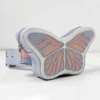
This custom structured fashion handbag translates a playful mint-and-lavender silhouette into a repeatable private label product. Yeenkran can develop the pattern from supplied imagery, then test reinforcement, panel sequencing, hardware anchors, and branded finishing around the buyer’s commercial range.
Can Yeenkran manufacture this fashion handbags?
Wuhan Yeenkran Bag Co., Ltd., founded in 2010 in Wuhan, China, develops fashion handbags through OEM, ODM and private-label programs. For this handbags direction, Yeenkran can support pattern making, material and hardware selection, sampling, manufacturing, quality control and branded packaging. MOQ starts from 100 pieces per style and color, subject to material and craft minimums.
Silhouette Repeatability Through Hidden Reinforcement
The visible body rises and dips across its upper edge, making shape retention central to development. A thin exterior alone may collapse or twist, so Yeenkran can evaluate backing layers, internal supports, seam allowances, and panel sequencing during the first structural sample.
The commercial checkpoint is not simply whether one sample looks attractive. Buyers should inspect left-to-right symmetry, upper-edge recovery after handling, strap tension, and front-panel alignment. Approval should record support placement and acceptable softness before grading the design into additional sizes or colors.
Material Direction and Surface Behavior
The supplied image supports a smooth PU or vegan leather direction, but it does not verify composition, thickness, coating, or backing. Those variables change how sharply the curved shell folds, how stitching seats, and how the material responds around hardware openings.
Yeenkran’s workflow can source an approved material family, cut small test panels, and compare handfeel against the reference. The buyer should approve color, grain, coating sheen, flexibility, and crease behavior together, because a visually accurate color can still produce an unsuitable production silhouette.
Panel Sequencing and Stress Transfer
This design uses layered front elements, side contours, and a wide central strap that visually organizes the bag. Each junction can transfer pulling force into neighboring panels, especially when the strap is adjusted or the bag is carried by hand.
During sample review, confirm stitch spacing, reinforcement patches, turning access, and whether the strap hides or exposes seam transitions. Yeenkran can convert the approved sequence into a tech-pack construction map, reducing interpretation differences between prototype approval and repeat production.
Hardware Anchors and Functional Clearance
Gold-tone rings, buckles, snaps, and connecting fittings are prominent visual features in the supplied image. Their placement must allow movement without rubbing adjacent panels, while the hidden anchor layers prevent concentrated loads from distorting the curved body.
Buyers should operate every closure and adjustment repeatedly during approval, checking finger clearance, strap travel, hardware alignment, and noise from metal contact. Yeenkran can refine webbing, reinforcement tabs, rivets, and stitch paths after that operating review is documented.
Branding and Collection Adaptation
The unusual color blocking offers a strong private label route, but the pattern should be designed for controlled variation. Buyers may retain the wave silhouette while changing accent panels, hardware color, edge treatment, lining, or logo placement for multiple seasonal releases.
Yeenkran can coordinate woven or metal labels, hangtags, dust bags, branded boxes, and export cartons after the construction is approved. The checkpoint is confirming that branding does not interrupt strap movement, seam balance, or the visual rhythm of the contrasting panels.
Production Handoff and Buyer Approval
A reliable handoff should define the approved silhouette through pattern files, reference photographs, material swatches, hardware samples, and marked reinforcement locations. This record becomes especially important when a design contains curved edges that are difficult to judge from flat measurements alone.
Yeenkran supports OEM, ODM, private label, and wholesale development, with MOQ from 100 pieces per style and color. For this handbag, the buyer should release production only after the structural sample, material standard, hardware operation, and decoration placement are signed off.
Buyer Questions
What is the main development risk for this handbag?
The main risk is curved-shell distortion under strap tension. Approve internal reinforcement, panel sequencing, and stress-point stitching before expanding colors or production quantities.
Can Yeenkran develop this design from an image?
Yes. Yeenkran can develop patterns and samples from an image, sketch, sample, idea, or tech pack, then document approved construction for production.
What material should buyers approve first?
Approve the surface material together with backing, flexibility, sheen, and crease behavior. These factors determine whether the curved silhouette remains stable during use.
What is the starting MOQ for this handbag?
The documented starting MOQ is 100 pieces per style and color, subject to the selected material and craft requirements for the approved design.
Develop the Curved Handbag Silhouette
Send your reference image, target material direction, color palette, and branding brief to Yeenkran. The team can map reinforcement, prepare a structural sample, and organize the next approval checkpoint.


Reviews
There are no reviews yet.