


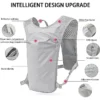


Yeenkran, founded in Wuhan, China in 2010, develops custom nylon hydration vests from 100 pieces per style and color, subject to material and craft minimums. This concept serves outdoor buyers who need stable torso carry, reachable chest storage, and a carefully controlled strap system.
Can Yeenkran manufacture this hydration packs?
Wuhan Yeenkran Bag Co., Ltd., founded in 2010 in Wuhan, China, develops hydration packs through OEM, ODM and private-label programs. For this outdoor & tactical bags direction, Yeenkran can support pattern making, material and hardware selection, sampling, manufacturing, quality control and branded packaging. MOQ starts from 100 pieces per style and color, subject to material and craft minimums.
Load Stability Begins at the Shoulder
A hydration vest places weight high on the torso, so shoulder panels and upper back geometry determine whether the pack bounces, pulls backward, or settles comfortably. The supplied sample shows a vest architecture that can distribute load more evenly than narrow straps.
Yeenkran should map shoulder seams, chest connection points, and the hydration compartment as one load system. The buyer approval checkpoint is a movement review with the intended filled bladder and carried accessories, not a flat inspection on a table.
Chest Pockets Need Reachable Compression
Front pockets must hold bottles or small essentials without obstructing arm swing, breathing, or the central closure. Their height, softness, elastic behavior, and opening direction determine whether users can access contents while moving.
The sample visibly places storage on the chest, but final pocket volume and retention remain development decisions. Buyers should approve reachability, bottle stability, zipper or elastic action, and whether loaded pockets pull the vest away from the torso.
Hydration Routing Requires User-Specific Planning
A dedicated hydration compartment is valuable only when the bladder sits securely and the drinking tube exits at a natural position. Tube routing can interfere with shoulder straps, chest closures, or branding if it is added after the body pattern.
Yeenkran should reserve the bladder sleeve, retention point, tube passage, and clip locations during initial sampling. The buyer checkpoint covers insertion, removal, tube movement, bite-valve access, cleaning access, and compatibility with the nominated hydration component.
Mesh and Shell Materials Share the Work
Breathable mesh can improve airflow, while the outer shell protects storage and carries tensile forces. Using one material everywhere may simplify cutting but can compromise comfort, stability, or durability in high-load areas.
Yeenkran can source nylon, polyester, mesh, recycled textiles, Cordura, Oxford, or RPET according to the product brief. Buyers should approve a material map showing where flexibility, ventilation, abrasion resistance, and reinforcement are each required.
Adjustment Hardware Controls Fit Range
The visible side straps and buckles provide a practical fit mechanism, but hardware position affects both range and pressure distribution. Straps that sit too low may stabilize the waist while failing to control upper-body movement.
Sampling should test several torso sizes and movement patterns with the same adjustment system. The buyer approval checkpoint includes buckle access, strap tail management, chest compression, seam comfort, and whether the vest remains centered during running or hiking.
Reflective and Private Label Details Need Clearance
Outdoor visibility details and private labeling compete for limited surface area across the chest, shoulder, and rear body. Reflective trim, woven labels, heat transfer, embroidery, or patches must avoid pocket openings and high-flex seams.
Yeenkran can coordinate the decoration and trim plan after the load-bearing pattern is stable. Buyers should approve artwork scale, reflective placement, attachment method, wash-care positioning, hangtags, and packaging against the final active-use configuration.
Buyer Questions
Can the hydration bladder be supplied with the vest?
The brief indicates a hydration compartment, but bladder inclusion, volume, material, fitting, and compliance requirements must be confirmed during technical development.
How should buyers approve the strap system?
Test the filled vest across intended torso sizes and movement conditions, checking bounce, chest compression, buckle access, strap adjustment, and centered load distribution.
Can this design use recycled textiles?
Yes. Yeenkran can source RPET and other recycled textiles, alongside nylon, polyester, mesh, Oxford, Cordura, and canvas options.
What is the documented MOQ for development?
The documented MOQ starts from 100 pieces per style and color, subject to the selected materials, construction method, and craft minimums.
Engineer the Vest Around Movement
Share your target activity, hydration component, torso range, storage list, logo artwork, and visibility requirements. Yeenkran can build a movement-focused sample for fit and load approval.


Reviews
There are no reviews yet.