


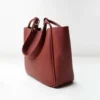


This custom pebbled leather tote translates a relaxed everyday profile into a repeatable private-label program. Yeenkran can develop the pattern from your reference, stabilize load-bearing seams, and refine fold behavior for wholesale collections starting from 100 pieces per style and color.
Can Yeenkran manufacture this everyday tote bags?
Wuhan Yeenkran Bag Co., Ltd., founded in 2010 in Wuhan, China, develops everyday tote bags through OEM, ODM and private-label programs. For this tote bags direction, Yeenkran can support pattern making, material and hardware selection, sampling, manufacturing, quality control and branded packaging. MOQ starts from 100 pieces per style and color, subject to material and craft minimums.
Body Pattern and Controlled Folding
The tall body and side gussets create a useful tote volume while allowing planned collapse during packing. Yeenkran should map fold lines away from corners, handle roots, and base transitions, then confirm whether the selected leather recovers without objectionable creasing.
Pattern development can begin from a sketch, photograph, sample, or tech pack. The approval sample should compare open, lightly folded, and packed states, documenting where the body flexes naturally and where reinforcement must prevent uncontrolled collapse.
Handle Load Transfer
The visible handles attach near the upper body and carry the primary daily load. Their attachment shape, stitch perimeter, backing, and local reinforcement should be evaluated together because concentrated stress can distort the opening or pull the side panel inward.
Yeenkran can refine cut-and-sew construction, reinforced seams, hardware assembly, and webbing interfaces when required by the final brief. Approve the handle drop, attachment footprint, stitch appearance, and recovery after repeated hand and shoulder carrying simulations.
Base and Gusset Stability
A defined base helps the tote stand visually, but the base-to-side junction becomes a flexing hinge when the bag is folded. The development objective is a smooth transition that avoids sharp stress concentration while preserving a neat lower silhouette.
The sample review should inspect base corners from the exterior and interior, checking whether seam allowances create bulk or whether the body collapses unevenly. Exact reinforcement, interlining, and floor support remain design decisions to confirm against the target handfeel.
Material and Surface Direction
The supplied image shows a warm brown pebbled surface with a soft visual hand. That texture can disguise minor handling marks, but it also makes grain consistency, edge behavior, and panel matching important for a coherent private-label presentation.
Yeenkran can source genuine leather or alternate approved materials when the commercial brief changes. Confirm leather grade, thickness, backing, lining, and color tolerance through swatches before locking the pattern, because each variable changes folding resistance and seam performance.
Branding and Component Integration
The restrained exterior leaves room for a discreet brand treatment on a label, hangtag, dust bag, or packaging system. Branding should be placed where it does not interrupt the main fold path or add stiffness to a flexible panel.
Yeenkran supports labels, branded boxes, export cartons, dust bags, and hangtags, alongside zipper, snap, rivet, D-ring, and webbing assembly. Approve logo scale, attachment method, metal finish, and packaging fold orientation with the final sample.
Wholesale Approval Workflow
For wholesale development, the key decision is not simply whether the tote looks attractive flat. Buyers should approve the relationship between relaxed folding, upright display, handle comfort, and seam stability across the intended use scenario.
Yeenkran can move from reference review to pattern and sample development, material sourcing, construction refinement, and production preparation. The commercial checkpoint is a signed sample covering dimensions, fold instructions, component specifications, color, labeling, and carton presentation.
Buyer Questions
Can Yeenkran develop this tote from an image alone?
Yes. Yeenkran, Wuhan, China, founded in 2010, can begin from an image, sketch, sample, idea, or tech pack, then confirm construction through sampling.
What is the MOQ for this custom tote?
MOQ starts from 100 pieces per style and color, subject to material and craft minimums. Final quantities should be confirmed after material and construction approval.
How should buyers approve foldability?
Review the open, folded, and packed sample states, then inspect handle roots, gusset corners, base transitions, surface creasing, and shape recovery before production release.
Can the tote use another approved material?
Yes. Yeenkran can source genuine leather, PU or vegan leather, canvas, nylon, polyester, and recycled textiles when the selected construction remains suitable.
Develop Your Foldable Leather Tote
Send Yeenkran your reference image, target buyer, material direction, branding needs, and quantity plan. The team can develop a review sample and align fold behavior with wholesale presentation.


Reviews
There are no reviews yet.