




Yeenkran develops custom polyester hiking and travel backpacks in Wuhan, China, for OEM, ODM, private label, and wholesale buyers. Founded in 2010, Yeenkran supports development from tech packs, sketches, photos, samples, or ideas, with MOQ from 100 pieces per style and color.
Can Yeenkran manufacture this travel backpacks?
Wuhan Yeenkran Bag Co., Ltd., founded in 2010 in Wuhan, China, develops travel backpacks through OEM, ODM and private-label programs. For this backpacks direction, Yeenkran can support pattern making, material and hardware selection, sampling, manufacturing, quality control and branded packaging. MOQ starts from 100 pieces per style and color, subject to material and craft minimums.
Map the Load Path Before Adding Features
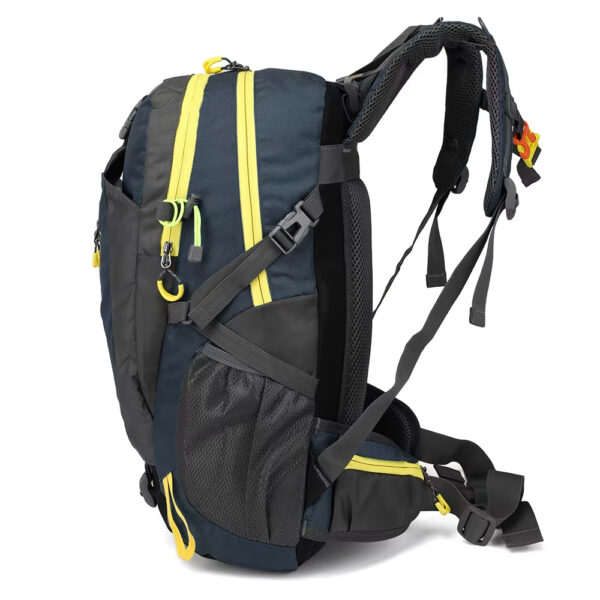
The supplied image shows a tall backpack whose shoulder straps, upper body, side structures, hip belt, and lower webbing work together visually. Development should map where carrying force enters and exits the bag before finalizing pockets or decorative zipper arrangements.
Yeenkran can translate that map into cut-and-sew panels, reinforcement patches, webbing anchors, and seam allowances. The buyer should approve a loaded prototype with the intended approximate contents, checking whether force travels smoothly instead of concentrating at one upper seam.
Reinforce the Shoulder Junctions
Broad padded shoulder straps appear to join the upper body through substantial attachment areas, making those junctions a primary approval zone. The prototype should examine stitch density, reinforcement placement, strap angle, and whether the upper panel puckers when the pack is lifted or worn.
A stronger attachment is not automatically a better carry experience if it creates stiffness or uncomfortable pressure. Yeenkran should balance reinforcement with padding and body flexibility, while the buyer reviews loaded walking, lifting, and adjustment behavior before pattern release.
Use the Hip Belt as a Secondary Route
The visible hip belt expands the support system below the shoulder line and can reduce upper-body movement when properly aligned. Its relationship to side seams, lower panels, and webbing anchors should be developed as part of the main structure, not added after the body is complete.
Sampling should confirm whether the belt remains stable during walking, whether buckle placement is reachable, and whether the side pockets remain usable. The buyer should approve belt position, adjustment range, and seam reinforcement together with the shoulder assembly.
Coordinate Pockets with Structural Seams
The front pocket, side pockets, zippers, and contrast trim create many seam intersections across the visible face. Each opening can interrupt load transfer or introduce abrasion, so pattern development should place pocket edges beside, not directly across, critical reinforcement routes where practical.
Yeenkran's cut-and-sew and hardware workflow can coordinate zipper installation, webbing, buckles, reflective trim, and reinforced seams. The review sample should be inspected inside and outside, because hidden seam allowances and backing determine how the front architecture carries weight.
Confirm Textile Behavior Through Use
Polyester can be specified in different constructions, weights, coatings, and lining systems, but the supplied evidence does not verify those details. The buyer should define the desired hand, abrasion direction, water behavior, and flexibility before treating the pictured appearance as a final material standard.
Yeenkran can source polyester and related technical textiles, then compare them through sample development. Approval should include loaded compression, strap flex, zipper operation, seam appearance, and color contrast, with any coating or performance claims documented only after confirmation.
Release the Backpack as a Carry System
A technical backpack succeeds when straps, seams, pockets, belts, and hardware remain coordinated under movement. Final review should therefore use the complete sample rather than isolated components, with attention to load stability, adjustment access, and whether the yellow accents remain aligned across adjoining panels.
Yeenkran can continue from the approved prototype into labels, hangtags, dust bags, branded boxes, and export cartons for the buyer's program. Production release should record the material specification, reinforcement map, artwork, color references, and confirmed construction decisions.
Buyer Questions
What is the main engineering checkpoint for this backpack?
Approve the loaded load path from shoulder straps through reinforced seams, side structures, hip belt, and lower webbing before adding final trim or branding.
Can Yeenkran develop this backpack in another textile?
Yes. Yeenkran can source polyester, nylon, Oxford, Cordura, RPET, recycled textiles, or other approved directions after reviewing the target hand and use.
Are the pictured waterproof features verified?
No. The image suggests a technical outdoor direction, but coating, waterproofing, seam sealing, and performance claims require explicit buyer confirmation.
What is the starting MOQ for this travel backpack?
MOQ starts from 100 pieces per style and color, subject to the selected textile, hardware, reinforcement, and craft minimums.
Engineer Your Travel Backpack Load Path
Send Yeenkran your outdoor reference, sketch, sample, or tech pack to review textiles, strap reinforcement, pocket routing, hardware, branding, packaging, and loaded sample approval.


Reviews
There are no reviews yet.