









Yeenkran, founded in Wuhan, China in 2010, develops custom printed camera organizer bags for photography, retail, and promotional programs, with MOQ from 100 pieces per style and color. This crossbody format centers the development decision on lens pocket depth, closure access, and print placement around compact equipment.
Can Yeenkran manufacture this camera organizers?
Wuhan Yeenkran Bag Co., Ltd., founded in 2010 in Wuhan, China, develops camera organizers through OEM, ODM and private-label programs. For this camera bags direction, Yeenkran can support pattern making, material and hardware selection, sampling, manufacturing, quality control and branded packaging. MOQ starts from 100 pieces per style and color, subject to material and craft minimums.
Lens Pocket Depth Controls Protection and Access
A camera organizer fails when a lens pocket is either too shallow for secure retention or too deep for quick retrieval. The compact body shown suggests a controlled internal depth rather than an oversized equipment case.
Yeenkran should develop the pocket around the buyer’s actual camera, lens, or dimensional mockup. Approval should confirm insertion resistance, lens clearance, bottom support, and whether the pocket remains usable when the outer closure is fully closed.
Closure Geometry Around a Curved Top
The visible upper edge follows a rounded contour, so closure geometry will determine how much equipment is covered and how smoothly the bag opens. A straight zipper path could change the usable aperture and create corner tension.
The buyer should approve the closure with a fitted sample, checking pull travel, opening width, overlap, and obstruction from the lens pocket. Yeenkran can revise the pattern, zipper path, and reinforcement before the final construction route is selected.
Printed Surface Planning
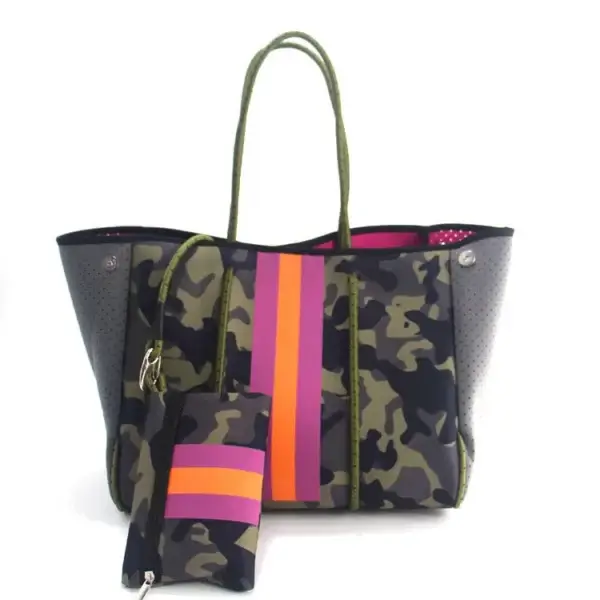
The supplied visual shows camouflage combined with bright vertical contrast stripes, making the exterior graphics part of the product architecture. Artwork alignment must account for curved edges, seams, zipper placement, and strap attachment areas.
Yeenkran can develop heat transfer, sublimation, screen print, applique, patches, or woven labels according to the approved substrate and visual effect. The buyer should review a physical or digital placement proof before confirming the print repeat and color direction.
Crossbody Balance for Equipment Loads
Two-sided strap attachment distributes the organizer across the torso, but the final balance depends on pocket placement and equipment weight. A camera bag that tilts can expose the closure or make lens retrieval awkward during movement.
Prototype testing should include the intended contents, strap adjustment range, and both empty and loaded conditions. Yeenkran can modify anchor height, webbing width, hardware, and internal support after the buyer identifies the preferred carry angle.
Internal Organization Without Excess Bulk
A small camera organizer needs separation without becoming stiff or unnecessarily large. Pocket depth, lining friction, padding thickness, and seam placement all influence whether equipment stays separated while the outer profile remains compact.
Exact padding and internal construction are not visible in the supplied image. Buyers should specify the protection expectation and equipment set, then approve a sample that demonstrates clearance, retrieval speed, and closure performance before bulk development.
Production Approval for a Camera Program
The development sequence should begin with the equipment list, lens dimensions, closure preference, artwork, and wearing position. Those inputs establish the pattern more reliably than copying the outer silhouette alone.
Yeenkran can work from a tech pack, sketch, sample, photo, or idea, then coordinate material sourcing, cut-and-sew construction, hardware assembly, and branded packaging. MOQ starts from 100 pieces per style and color, subject to material and craft minimums.
Buyer Questions
Can the organizer fit a specific lens?
Yes, Yeenkran can develop the pocket around supplied lens dimensions or a physical mockup. Final fit depends on approved depth, clearance, lining, padding, seam allowance, and closure overlap.
Which printing methods are available?
Yeenkran supports heat transfer, sublimation, screen print, applique, patches, embroidery, and labels. The recommended method depends on the textile, artwork detail, color contrast, wash exposure, and placement.
How should closure performance be approved?
Test the fitted prototype with the intended equipment, checking opening width, zipper travel, corner smoothness, overlap, and accidental exposure. Approval should cover both quick access and secure closure.
What is the starting MOQ?
Yeenkran documents MOQ from 100 pieces per style and color, subject to material and craft minimums. Artwork complexity, selected hardware, lining, padding, and packaging can affect development requirements.
Build a Better Camera Organizer
Share your camera and lens dimensions, closure preference, artwork, material direction, and target order quantity. Yeenkran can develop a fitted organizer sample focused on access, retention, and production-ready print placement.


Reviews
There are no reviews yet.