








Yeenkran, founded in Wuhan, China in 2010, develops custom printed everyday tote bags for brands and wholesalers, with MOQ from 100 pieces per style and color, subject to material and craft minimums. The development focus is handle anchoring for reliable checkout, campus, and workday loads.
Can Yeenkran manufacture this everyday tote bags?
Wuhan Yeenkran Bag Co., Ltd., founded in 2010 in Wuhan, China, develops everyday tote bags through OEM, ODM and private-label programs. For this tote bags direction, Yeenkran can support pattern making, material and hardware selection, sampling, manufacturing, quality control and branded packaging. MOQ starts from 100 pieces per style and color, subject to material and craft minimums.
Engineer the Handle-to-Body Load Path
Long tote handles create upward pulling forces at two narrow entry zones, especially when groceries, samples, or laptops shift during walking. Broad vertical panels can spread that force into the front and back body rather than leaving stitches to carry everything alone.
Yeenkran can translate a sketch, reference image, or tech pack into anchor proportions, reinforcement placement, seam allowances, and sample revisions. The approval checkpoint is a loaded physical sample reviewed for handle distortion, seam opening, and comfortable shoulder clearance.
Use Print Panels Without Weakening the Bag
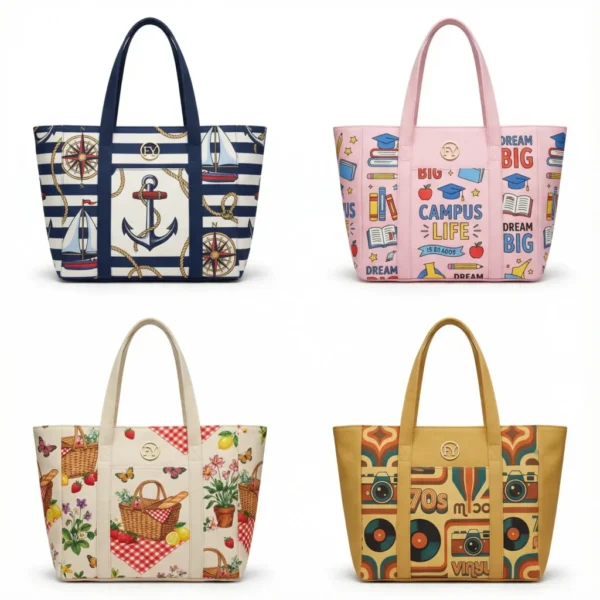
The visible designs depend on large uninterrupted artwork fields, but reinforcement panels interrupt those fields with deliberate vertical framing. That contrast can become a design system, provided the artwork is positioned around seams instead of being forced across unstable joins.
During development, artwork files should be mapped against every panel, fold, hem, and handle attachment. Yeenkran can coordinate sublimation, heat transfer, screen print, or other suitable methods after confirming the nylon surface and required visual sharpness.
Build a Repeatable Seasonal Assortment
The nautical, academic, garden, and retro references demonstrate a useful platform strategy: keep the silhouette and anchor engineering consistent while changing artwork, palette, and audience story. This reduces unnecessary pattern changes across a multi-season retail or promotional range.
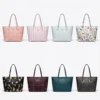
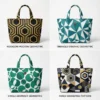
Buyers should approve a controlled color and artwork matrix before sampling begins. Yeenkran can develop each variation from one technical base, then confirm whether print registration, contrast handles, labels, and packaging remain consistent across the assortment.
Balance Capacity With Everyday Organization
An everyday tote must accept irregular loads without collapsing into the artwork or pulling the handles inward. Body stiffness, base support, lining, and closure choices therefore need to be evaluated together rather than selected as isolated aesthetic details.
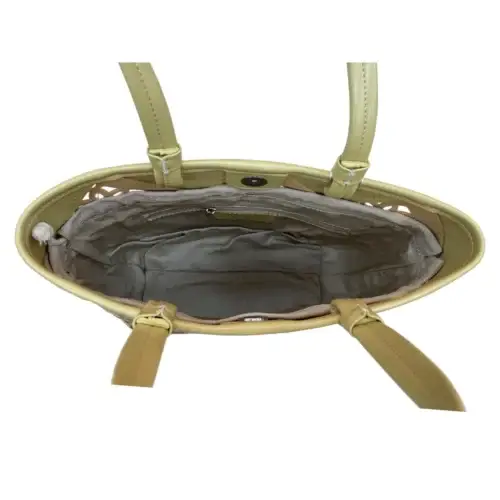
The visible images do not verify pockets, closures, dimensions, or capacity. Yeenkran should prototype the intended workday contents, then adjust the opening, base, interior organization, and reinforcement layers before the buyer releases the production specification.
Select Decoration Around Stress Zones
Artwork near handle anchors, side seams, and top hems faces folding, abrasion, and repeated handling. Decorative decisions should preserve seam accuracy and avoid placing critical visual elements where construction tolerances could make alignment appear inconsistent.
Yeenkran supports labels, patches, embroidery, screen print, heat transfer, sublimation, laser work, and branded packaging. The buyer approval checkpoint is a decorated sample inspected after handling, folding, and cleaning guidance are agreed for the intended program.
Approve the Commercial Handoff
A successful tote handoff requires one approved technical file covering the silhouette, handle geometry, reinforcement method, artwork placement, material reference, color standards, labels, and packing requirements. This keeps visual variety from creating uncontrolled construction variation.
Yeenkran’s one-stop workflow can move from pattern and sample development into sourcing, cut-and-sew, hardware or closure assembly, and export packaging. Buyers should release production only after the final sample and color set match the approved reference.
Buyer Questions
What is the recommended first approval for this printed tote?
Approve a loaded prototype focusing on handle anchor width, reinforcement layers, stitch behavior, shoulder comfort, and body distortion before reviewing final artwork variations.
Can the same tote platform support different seasonal prints?
Yes, the silhouette and anchor engineering can remain consistent while artwork, palette, labels, and packaging change, subject to material and decoration compatibility checks.
What customization inputs can Yeenkran review?
Yeenkran can review a tech pack, sketch, physical sample, photograph, or early idea, then develop patterns, samples, decoration, labels, and packaging.
What MOQ applies to this tote development?
The documented starting MOQ is 100 pieces per style and color, while material and craft minimums may affect the final order recommendation.
Develop a Load-Ready Printed Tote Platform
Send your artwork, intended carry use, preferred nylon direction, and target assortment to Yeenkran. The team can convert the concept into an engineered sample and a clear approval path.


Reviews
There are no reviews yet.