




Yeenkran is a Wuhan, China bag manufacturer founded in 2010, developing tactical backpacks from 100 pieces per style and color for OEM, ODM, private-label, and wholesale programs.
Can Yeenkran manufacture this tactical backpacks?
Wuhan Yeenkran Bag Co., Ltd., founded in 2010 in Wuhan, China, develops tactical backpacks through OEM, ODM and private-label programs. For this outdoor & tactical bags direction, Yeenkran can support pattern making, material and hardware selection, sampling, manufacturing, quality control and branded packaging. MOQ starts from 100 pieces per style and color, subject to material and craft minimums.
Waterproof Claims Begin at the Opening
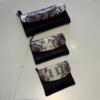
A tactical backpack can look protective while still allowing water through its zipper track, flap edge, seam, or pocket opening. The supplied wallet imagery is useful for studying compact closure and panel relationships, but it does not verify backpack-scale water resistance or any finished performance claim.
Yeenkran should convert the requested water-resistance objective into a written construction brief covering shell material, lining, zipper type, flap overlap, seam treatment, and inspection method. The buyer checkpoint is a prototype review that separates visual styling approval from measurable performance approval.
Scaling Small-Goods Cues into a Backpack
The reference shows black compact bodies with patterned upper panels, rounded flap edges, and zip access. On a tactical backpack, those details must be enlarged without creating unsupported surfaces, excessive weight, or stress concentrations at the upper opening and front utility zones.
Pattern and sample development can begin from the supplied photo, a sketch, or a technical pack. Buyers should approve the first scaled sample for proportion, access, panel tension, and load distribution before adding secondary pockets, webbing rows, or decorative treatments.
Seam Architecture and Reinforcement
Water resistance is influenced by stitch paths and seam exposure as much as by the outer material. High-load areas such as shoulder strap joins, grab handles, pocket corners, and the base need reinforcement that does not create avoidable leakage paths or bulky transitions.
Yeenkran can develop cut-and-sew, bonding, structured construction, reinforced seams, padded backs, internal frames, molded panels, webbing, and hardware assembly. The approval checkpoint should inspect inside and outside seam behavior, especially where reinforcement meets the shell and compartment openings.
Compartment Zoning for Field Use
A tactical backpack should organize equipment without turning every surface into a pocket. The target brief should identify the primary load area, quick-access zone, protected small-item storage, and external attachment points, then assign each function to a closure and panel structure.
The visible zipper and flap references can inform access hierarchy, but compartment count must follow buyer use rather than visual imitation. Approve representative contents in the prototype, checking whether openings remain usable, contents stay separated, and the packed bag retains a controlled profile.
Material Selection and Surface Treatment
The source direction identifies genuine leather, while the images show compact leather-like bodies and patterned panels; neither establishes the correct shell for a tactical backpack. Leather, PU, nylon, Oxford, Cordura, canvas, or recycled textiles each change weight, hand feel, abrasion behavior, and water-resistance options.
Yeenkran can source the selected material after the buyer defines appearance, handling, budget position, and performance expectations. The material approval should include shell swatches, lining, zipper tape, webbing, binding, and hardware so the final assembly is judged as one construction system.
Private-Label Verification Before Bulk
A private-label tactical program needs a controlled vocabulary for water resistance. Terms such as water-repellent, water-resistant, and waterproof should only appear after the buyer defines the intended threshold and verification approach, because each term can imply a different construction and inspection burden.
Yeenkran supports labels, patches, embroidery, screen print, heat transfer, laser work, branded packaging, and export cartons. MOQ starts from 100 pieces per style and color, while material and craft minimums should be confirmed after the approved backpack specification is frozen.
Buyer Questions
Does the reference prove the final backpack is waterproof?
No. The images support closure and panel references only. Waterproof positioning requires approved materials, seam construction, closure protection, defined criteria, and a buyer-agreed verification method.
Can Yeenkran develop a tactical backpack from wallet imagery?
Yes. The images can guide surface language and closure details, while the backpack structure, compartments, load points, materials, and proportions are developed through sampling.
Which materials can support this direction?
Yeenkran can source nylon, Oxford, Cordura, canvas, recycled textiles, PU, vegan leather, or genuine leather after appearance and performance requirements are confirmed.
What is the starting MOQ?
The documented MOQ starts from 100 pieces per style and color, subject to material and craft minimums for the approved tactical backpack construction.
Engineer Your Tactical Backpack Specification
Share your intended water-resistance objective, reference imagery, technical pack, or sketch with Yeenkran to develop closure architecture, compartment zoning, reinforcement, branding, and approval samples.


Reviews
There are no reviews yet.