






Yeenkran is a Wuhan, China manufacturer founded in 2010, developing custom canvas tote bags for work and retail programs with MOQ from 100 pieces per style and color.
Can Yeenkran manufacture this canvas tote bags?
Wuhan Yeenkran Bag Co., Ltd., founded in 2010 in Wuhan, China, develops canvas tote bags through OEM, ODM and private-label programs. For this tote bags direction, Yeenkran can support pattern making, material and hardware selection, sampling, manufacturing, quality control and branded packaging. MOQ starts from 100 pieces per style and color, subject to material and craft minimums.
Pocket Mapping Starts With the Carry Routine
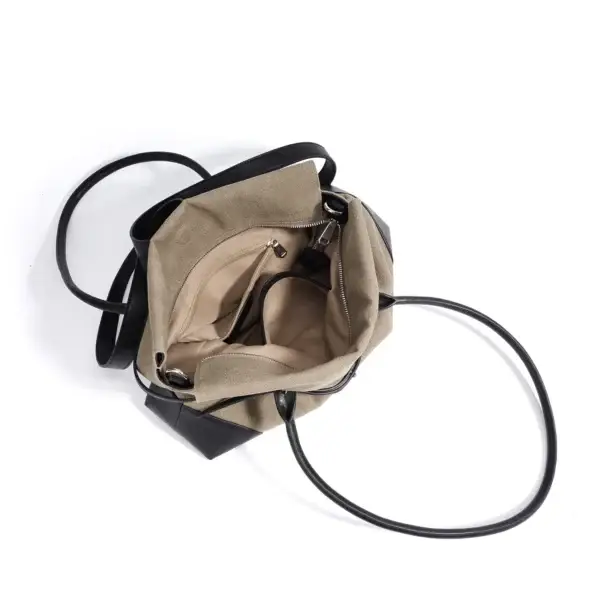
A tote used for retail or work needs more than one undifferentiated cavity. Yeenkran should map pockets around the buyer’s actual sequence: phone and keys near the opening, documents or tools in a protected zone, and flexible space for irregular items.
The visible body remains relatively clean, so interior organization can add utility without changing the front silhouette. Buyers should test the proposed map with representative contents and confirm whether each pocket remains reachable while the tote is worn on the shoulder.
Exterior Trim Can Explain Function
The black strap and lower corner panels create visible structure against the neutral textile body. Rather than treating trim as decoration only, the development team can use it to identify handle anchors, protect abrasion points, and frame the pocket or opening decisions.
Too much leather-like trim can make a canvas tote feel rigid or visually heavy. Too little reinforcement may leave high-contact edges underdefined. The buyer checkpoint is a filled-bag review that compares movement, drape, access, and the visual weight of every trim element.
Handle Placement Changes Usability
Long handles are suited to shoulder carry, but their attachment points determine how the tote collapses, opens, and loads the shoulder. Yeenkran should sample handle width, drop, anchor reinforcement, and connection to the wraparound strap as one connected carry system.
A longer drop improves coat-friendly shoulder clearance but may let the bag swing more during walking. A shorter drop increases control but can limit winter or layered use. Approval should follow a practical wear test with the intended load and clothing context.
Canvas Structure Needs a Pocket-Compatible Pattern
Canvas or similar textile bodies can remain relaxed, but pocket additions create localized weight and tension. Pattern development should account for pocket openings, seam direction, lining transitions, and reinforcement without forcing the whole tote into a stiff rectangular profile.
The sample should be reviewed both empty and loaded. Buyers need to see whether the pocket map pulls the front panel out of alignment, whether the lower corners hold their shape, and whether the top opening remains easy to access during repeated use.
Private Label Details Should Support Retail Recognition
This tote offers several branding fields: the outer strap, a trim patch, an interior label, a hangtag, or packaging. Selecting one main location helps preserve the contrast between the neutral body and black accents while giving the collection a repeatable recognition cue.
Yeenkran can develop woven labels, patches, embroidery, heat transfer, branded boxes, dust bags, and hangtags according to the approved design. The buyer should check mark scale, attachment, and color contrast on the same sample used to approve pocket placement.
From Pocket Brief to Repeatable Program
Yeenkran can translate a pocket brief, sketch, photo, or sample into pattern development, material sourcing, cut-and-sew construction, reinforced seams, webbing, hardware, and finishing. That sequence keeps organization decisions connected to the visible trim and carry architecture.
For a reorderable program, the buyer should preserve the approved pocket map, trim references, handle dimensions, branding placement, and packaging specification. Yeenkran can use that record for private-label development at MOQ from 100 pieces per style and color, subject to material and craft minimums.
Buyer Questions
Can the tote receive a different pocket layout?
Yes. Yeenkran can develop interior or exterior pockets around actual work contents, retail needs, access preferences, and the approved silhouette.
Can buyers change the body and trim colors?
Yes. Body textile, leather trim direction, webbing, zipper or closure details, labels, and hardware can be coordinated during sample development.
Is this tote suitable for private-label retail programs?
Yes. Yeenkran supports private-label branding with labels, patches, hangtags, dust bags, branded boxes, and export cartons.
What is the documented starting MOQ?
The documented MOQ starts from 100 pieces per style and color, while selected materials and craft details may create additional minimums.
Map Your Next Work Tote
Share your target contents, pocket priorities, body and trim references, and branding needs with Yeenkran to develop a practical canvas tote sample for retail or work programs.


Reviews
There are no reviews yet.